
Saturday, March 28, 2015
Weekly Animal Spotlight 6: Portuguese Man-Of War
The Portuguese man-of war is a beautiful creature that is also very deadly. It is made of other animals that build up the man of war itself. the animals are called zooids, and they connect to one another to build it up. It lives at the top of the ocean and can deliver a painful sting. The man-of war has no means of propulsion, so it can only move from wind and ocean currents. A way of helping with a sting is putting salt water on top of the wound, do not use fresh water, it tends to make the affected area worse.

Monday, February 16, 2015
weekly animal spotlight 5: Chinese ring-necked pheasant
Hi guys! this is my very first bird spotlight!
 the Chinese ring-neck pheasant is in the Galliforme (game bird) family. They live throughout Asia and their scientific name is Phasianus cholchicus. they have a call that sounds a lot like a chickens (Gallus gallus domesticus) call. there are a wide veriety of forms of male pheasant color. They have 30 subspecies and some of them are domesticated. As with many other species of game bird, they are very commonly hunted. Some of their predators are humans (Homo sapiens), grey foxes (Urycyon cenereoargenteus), and coyotes (Canis latrans).


the Chinese ring-neck pheasant is in the Galliforme (game bird) family. They live throughout Asia and their scientific name is Phasianus cholchicus. they have a call that sounds a lot like a chickens (Gallus gallus domesticus) call. there are a wide veriety of forms of male pheasant color. They have 30 subspecies and some of them are domesticated. As with many other species of game bird, they are very commonly hunted. Some of their predators are humans (Homo sapiens), grey foxes (Urycyon cenereoargenteus), and coyotes (Canis latrans).Friday, February 6, 2015
weekly animal spotlight 4: moose
hi guys! I'm back with another weekly animal spotlight!
The moose, is an amazing and beautiful animal from North America and Europe. they eat most land and aquatic plants, and its scientific name is Alces alces. They mainly live in decideous and boreal forests. their main predators are grey wolfs (Canis lupus), brown bears (ursus arctos), and humans (Homo sapiens). Once, some were introduced into New Zealand, and (possibly) went extinct.


The moose, is an amazing and beautiful animal from North America and Europe. they eat most land and aquatic plants, and its scientific name is Alces alces. They mainly live in decideous and boreal forests. their main predators are grey wolfs (Canis lupus), brown bears (ursus arctos), and humans (Homo sapiens). Once, some were introduced into New Zealand, and (possibly) went extinct.
Monday, January 12, 2015
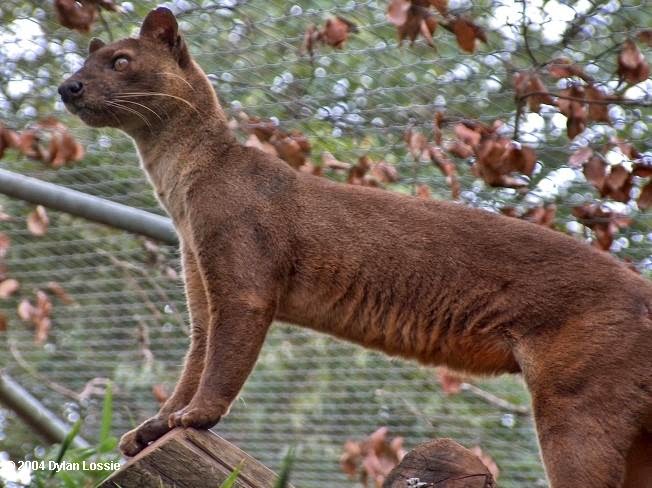
weekly animal spotlight 3: the Fossa
the Fossa is a strange animal from Madagascar. it is a carnivore and eats lemurs, and rodents. it looks as if it is a type of cat although it is actually closley related to mongooses, civets and Meerkats. Fossas are active both day and night and are very fast, adding to their incredible agility. they can climb trees very well and can jump very far. their scientific name is Cryptoprocta Ferox. sadly, not much more is known about the fossa.


Monday, January 5, 2015
weekly animal spotlight 2: reindeer
the reindeer is a interesting and famous animal that lives in Canada and Russia. Sadly reindeer probably do not fly, though they are kept in herds and raised. Up in the north where they live, reindeer cheese is very popular. their scientific name is Rangifer Terandus. They are related to all species of deer, and many predators target them. predetors include arctic wolfs, (Canis Lupus Arctos) and arctic foxes (Vulpes Lagopus). They have large antlers and light brown fur. They eat mosses, ferns, and grasses. Every year large herds of reindeer migrate 1,000,000 miles. Along the way, they can get parasites that make them weak, and targets for predators.


Tuesday, December 23, 2014
weekly animal spotlight 1: the okapi
If you are reading this right now, you probably do not know what an okapi is or if it even exists. It does exist and it is a animal that lives in the Congo of Africa. Their scientific name is Okapia Johnstoni. An okapis fur is dark and it has stripes on it's legs. They have a similar body shape to their only reletive the giraffe ( Girrafa Camiloparis) exept they do not have as long a neck as a giraffe. it has a long, flexible, blue tongue and eats leaves with it. the males have skin-covered horns called occicones on their head. They have long ears to help them detect predetors, such as the leopard ( Panthera Pardus). They are very shy and rarely seen. Occasionally they will eat charcoal. The okapi was not beleived to be real until the 20th century. the tribesman would tell stories of a kind of


 Donkey that resembled a zebra. later it was confirmed to be a real species. an okapi was later shipped to the Antwerp zoo in Europe. and later another shipped to the Bronx zoo. Patrick Putnam built a research area known as Epulu, and it was used to capture okapis and send them to zoos around the world. nowadays it is the Okapi research station were they capture and study Okapis. okapis have been endangered since 2003 and are protected. Okapis are a shy and little known animal.
Tuesday, July 22, 2014
ethiopian wolf
the ethiopian wolf is a wolf that lives in the ethiopian highlands. it is about the same size as a coyote (or prairie wolf). it has a very long and narrow skull and red and white fur. they live in seven isolated mountain ranges at 3,000- 4,500 meters. there are an estimated 360- 440 living in the ethiopian highlands making them criticly endangered! other names for it include the abyssinian wolf, simian fox, ethiopian jackal, red jackal, abyssinian dog, and cuberow. the earliest discription of them comes from aberdeen bestiary. he wrote, ethiopia produces wolfs with manes so diversly colored, men say, that no hue is lacking. a charicteristic of ethiopian wolfs is that they are extremely great jumpers. they never attack men however. in wenter they have a very long coat. but in summer they are hairless. the ethiopians call them theas. end qoute. they have two subspeices the northern ethiopian wolf, and the southern ethiopian wolf. suprisingly, unlike most large canids there favorite food is rats. but will also eat rock hyraxes, and occaisionally sedge leaves.

Tuesday, July 9, 2013
livvy is halarious
one time my little sister livvy came up to my mom and said i had a dream that daddy would not like! what? my mom asked. i had a dream abot a room full of kittens!


Saturday, March 31, 2012


Wednesday, February 22, 2012
Sunday, February 5, 2012
my weirdest dream
So i as at the beach with my famliy. We all had a car even my 4 year old little sister my mom decided to go out on the water. My house was in the dream when i was at the beach so thay wanted my brother to babysit. He told me to look in his shoe. When i lookt at his shoe there was a spider it seemd to me but it was a giant beetle!! It chast me and I ran up a window. I jumpt off the window and i lookt beind me. I suddenly saw there were a lot of beetles now and thay atakkt me! I ran in to my moms bed. I lookt down and the beetles were there. I closed my eyes and opend them. I lookt down and thay werent there so i had woken up! whew!
Tuesday, January 31, 2012
me

i love learning about animals and facts. I really want to take a trip to the Smithsonian. In the Smithsonian, there is a skeleton of a sea cow that I really want to see. They are like dugongs or manatees but they are from the dinosaur times. I would love to see more fossils. I want to see the National Zoo at the Smithsonian because some of the animals there that I want to check out and study are the red pandas, okapis, and the box jellyfish in the aquarium. If I could go to the linkoln memorial in Washington D.C. I would look at the statue of President linkoln.
Id like to know if it is possible if you can make portals. There are lots of things I want to know, so i want to go on some adventures.
Another trip I would love to take is to the Indy 500 to see the car races. That would be cool.
Wednesday, January 18, 2012
short beaked echidna

I want to share with you a little about the short beaked echidna. It lives in australia(including tasmania), new guinea. Here are some features the spines of this species, also called the spiny anteater are longer than the fur between them. Active both day and night this echidna is solitary. It eats ants termites grubs and worms. These are detected by smell and pherhaps by sensors on the long snout that detect eletric signals. The small head joins the shoulders with no external neck. i likethe ecidna becouse of is amaysing spines
Monday, November 7, 2011


livvy my little sister
livvy was a tiny girl. she was sow cute and she was sow sweet. She was my love of my life --oh yes she learned how to play nicly.


Wednesday, October 5, 2011
common snake neck turtle

yello spottid river turtle
one of lorger south amarican river turtle this speciecs can be recognized by its black or brown oval carapace wich has low keels on the secount and third scutes yellow spots on the side of the head.
african helmeted turtle
 also known as the marsh terrapin this sideneck turtle is fairly uniformly patterned olive green or suturing on the scutes.
Friday, July 29, 2011
Exploring

i went on an advinture up the mountin. we fond cat face spiders and stink bugs, spider webs and carvings, worm traks and crab fossels and last of all- moths!!!


me and bradon.......holding mommys hand

my mom and dad on our hike


my sister found worm tracks

more petrogliffs of some peaple


sommer found a sand doller fossil


I caught a moth, stink bug, and some artafacts. (fur and butterfly cocoon and catipiller. and aksadently a tiny cat face spider!!!

See that spider on my bug net!

My mom took sunset pictures

Look at all these spider webs!!! and spiders


my little sister

high up the mountain
Subscribe to:
Posts (Atom)